Rolling the Dice on Kickstarter: Tales from a TTRPG Addict
It was April 8, 2021 when I saw the first Kickstarter I backed post a “Funded Successfully” image on the updates section. It was a Kickstarter by Lorenzo Etherington for How to Think When You Draw — Volume 4. I had never even thought about participating in a Kickstarter prior to that. The thought of giving money to someone without a guaranteed product, or potentially waiting years for delivery, made Kickstarter unappealing to me.
Well, that first Kickstarter changed my way of thinking. It is just over 4 years later and I have backed 43 total items-mostly books-on Kickstarter, and an additional 8 to 10 on other sites such as Backerkit and Gamefound. That means I’m backing, on average, 12 projects a year-or better yet, one project a month.
In truth, my pledges usually come in spurts. I’ll back 4 to 6 in a month and then might not back anything for 2 to 3 months. I’m very specific about what I want to back, and it’s almost entirely TTRPG related. I obviously need to be sure of having the funds and I generally back at the mid-tier, but depending on the game — I’m looking at you Pirate Borg and Legend in the Mist — I’ll go big. In all the ones I’ve backed, there have only been 2 or 3 failures. Either they didn’t deliver all of the materials, or worse yet, they didn’t deliver anything. I won’t name those games or creators, but it does show that there is a chance for failure. Despite these occasional disappointments, I’d like to share the reasons I genuinely love backing Kickstarter TTRPGs.
Backing the Underdogs: Small Creators Matter
So this is easily the biggest reason why I back many of the projects that have come across my path. When you’re a small and independent creator without the funding to produce a product, it can seem insurmountable. The thought of paying for artists, publishing, delivery, and all the extra costs that might be related — stares at the current tariffs — can make the dream of producing your own TTRPG a hopeless wish. Kickstarter has partially leveled the playing field so those independent creators can finally produce their dream work.
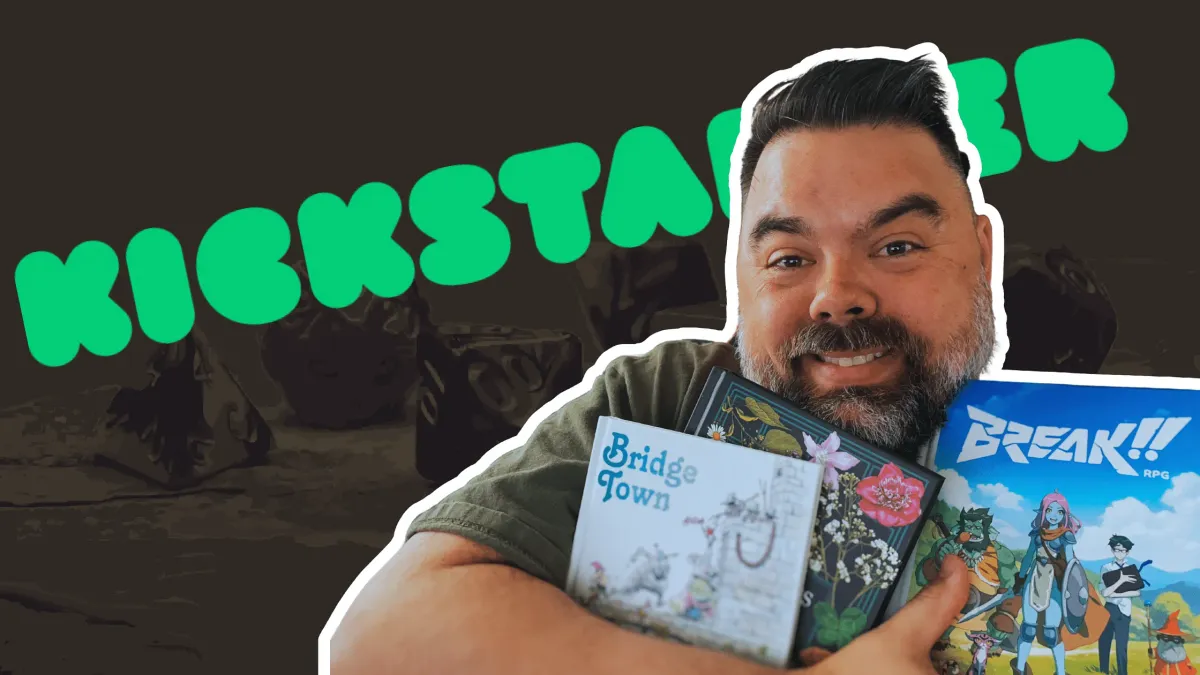
Out of all the projects my wife and I have backed, I would say about half have been independent creators. Without Kickstarter, I would never have discovered games like BREAK!! RPG, Little Game Masters, Bridgetown, or Tales from the Myriad. I wouldn’t have TTRPG supplements such as Herbalist Primer or Geologist Primer. These are all games that were created from the minds of people who long ago would never have been able to release that. I’ve used the Herbalist Primer in a Pathfinder 2E game and have hosted sessions of BREAK!! RPG and Little Game Masters. These games and supplements have allowed me to expand the systems I’ve been able to play. And of course, I get to help people bring their dream to fruition.
New Tools for the GM’s Arsenal
So anyone who has played with me knows that I like variety. I’m not the type of player who sticks to just one game system. I don’t hold anything against those that are like that. In fact, sometimes I wish I were, as it’d make it easier to remember things about the games I play. I’m more like a Pathfinder 2E gnome who is fighting against the Bleaching. For the uninitiated, gnomes in PF2E need to continually create and be curious about things to keep from becoming a shell of themselves over time. Oh, and I’m not the tallest either, so I suppose I’m closer to their stature as well.
I’m a voracious reader. I don’t watch a ton of television or film. But I enjoy sitting down and immersing myself in a book or PDF. There is something about letting my imagination revel in the written word. With Kickstarter TTRPGs, I will often see ways they do things and think about how I might incorporate that same way of thinking into the games I’m leading. Now, obviously, some of those ideas have to be tossed because trying to cram a different system’s mechanics into a game you’re already playing just creates more unnecessary work. And nobody wants more unnecessary work. Balancing inspiration with practicality is key.
For example, I attempted to incorporate Fate Points from the Fate system into a Pathfinder 2E game. It worked partially, but was not a big success, so I didn’t continue it. I like the idea of players having a bit more agency, such as what the Fate Points offer, but in the crunchiness of PF2E and with the players I had at the time, it didn’t mesh well. I’m not saying it couldn’t work for PF2E, but the circumstances didn’t work well.
On the other hand, I love the idea of stunts that are available in BREAK!! RPG, and so I will allow players in almost all games to give me a way they’d like to perform something outlandish. And I allow it. There might be a roll or two needed, but I’m open to the idea of teamwork-based stunts. I probably wouldn’t have been had I not read about it in BREAK!! RPG.
And of course, there is lore, monsters, and NPCs that I have used across games. These elements help breathe fresh life into each session, keeping players engaged and curious. With each new Kickstarter I receive, it increases the number of creatures I can use in my game. Never discount this fact.
The Perks of Being a Backer: Innovation Before Release
One of the most exciting aspects of backing tabletop RPGs on Kickstarter is having the chance to be on the cutting edge of game design. Long before a product hits retail shelves-or even digital storefronts-backers get to explore entirely new systems, mechanics, or narrative approaches. This early access can feel like stepping behind the curtain of the TTRPG industry, offering a sneak peek at the genre’s future.
For many, the appeal lies in discovering games that experiment with form and function. Take Brindlewood Bay from The Gauntlet, a storytelling game that mashes up cozy murder mysteries and cosmic horror. It was initially released in zine form, but its polished version found massive support on Kickstarter in 2023, raising over $470,000-far beyond its modest initial goal. Backers not only received the game before its widespread release but also got to watch it evolve in real time through development updates and community discussion.
Another standout is MÖRK BORG, a rules-light, art-heavy doom metal RPG that brought visual design to the forefront of game presentation. Its Kickstarter success helped establish a broader movement in visually experimental RPGs, influencing countless indie designers. Those who backed the campaign received it early and became part of a cultural moment in indie RPG publishing.
Backers often gain access to beta versions, playtest rules, or development blogs that allow them to engage with the game as it takes shape. This not only satisfies curiosity but also offers a tangible sense of ownership and investment in the final product. Currently I’ve been reading the continuous updates of Legend in the Mist by Son of Oak Games. They’ve been pretty good about sending out PDFs as the game progresses and gaining feedback from their audience. And their system is considerably different from the traditional D20 game, which means seeing the project progress allows the players to really understand it before the polished game is released.
Kickstarter serves as a launchpad for innovation-and being a part of that launch often means access to content months (or even years) before it reaches the broader market.
Delivery Dates and Disappointments
So let’s start to look at some of the risks for backers. The biggest one is going to be the missed delivery or non-delivery. I have found that many of the Kickstarters I’ve backed miss the date of delivery. As I said earlier in the post, only a couple have not delivered, so I will say I’ve been really lucky there. But, I have not been lucky in games hitting delivery dates.
I’ll use Tales from the Myriad as an example. This was a TTRPG that we backed partially because of the beautiful artwork and partially because it had a simple ruleset that could be crunchy if you so desired. I’ve been on their Discord since day one and appreciated all the updates. Its original estimated delivery was October of 2023. I received it in February or March of 2025 (I don’t remember exactly). Having said that, the creator was constantly giving updates online and letting us know what to expect and when to expect it. This eased my worry considerably. For a game that came so late, I have no issues with it taking so long. Sometimes it happens. But if you’re going to support a game on Kickstarter, you have to be aware that something like this may happen at some point.
On the other hand, there are two major projects that I was extremely excited about. I won’t name the Kickstarters as I don’t feel the need to have other people harass them. One was for a VTT alternative and another for a PF2E-related book. The VTT alternative was just a terrible situation. Many promises were made, but ultimately, nothing was delivered. I will say I paid a significant amount for that Kickstarter. It was originally supposed to release in November of 2022. And here we are, nothing to show for it. At least with the PF2E-related book, there is a PDF. Mostly complete. And usable. But still, paying for a hardcover and not receiving it can be extremely unsatisfying.
Backing Isn’t Buying: Understanding the Gamble
This then tumbles into the topic of the financial risk for backers. Look, the economy kind of sucks right now. I know this. I think most people do. And so spending money on something you might not see for a year-or ever-is a gamble that’s harder to justify than it used to be.
Backing a Kickstarter isn’t the same as pre-ordering from a major publisher or purchasing a finished game from a store. You’re not just buying a product-you’re funding the development of a project, often before it’s fully finished. And while that’s part of the appeal (getting in on the ground floor of something exciting), it also means you’re assuming the risk if things go sideways.
Unlike traditional purchases, there are no refunds if the creator runs out of money or loses the rights to the content they’re producing. It’s right there in Kickstarter’s terms of service. You could lose money on this investment. You’re investing trust in the team’s ability to manage logistics, budgeting, and production. That’s a big ask, especially for new or untested creators. Even veteran publishers can run into trouble if stretch goals spiral out of control or global supply chains throw a wrench into manufacturing timelines. This is evident in one of the companies I’ve backed who currently have 5 or 6 “Kickstarter-like” products out that have not been delivered. There is honest worry that we may never see final products.
Kickstarter FOMO Is Real (And Costly)
Finally, and this is where Kickstarter can get you, there is the fear of missing out and overspending when you don’t really have the means for it. It has happened to us. Some of the projects we’ve backed probably shouldn’t have been. In fact, at times I’ve backed several similar projects (like 3 Virtual Table Tops, when I’d only use one anyway). But they look so good, and the intro video seems so polished, so I should just spend the money and get all of the things.
No, no I should not. We all get that way. We want to be part of something new and important. We want to get in on the ground floor. We want to be able to tell people in 10 years that we were there when a game first started. I’ve been known to do it. I was in the Alpha for Overwatch, the video game by Blizzard. I’ve mentioned that multiple times to people. It makes me feel special. But truth is, it’s unimportant. Whether or not we are part of the beginning of something isn’t as important as whether or not we are enjoying our time with the game in that moment.
And yes, do I want all of the books? Do I love having the physical books in my hand and reading it that way? Of course I do. But that shouldn’t be a determining factor on whether or not I spend the money. I’ve come to realize that PDFs are just as good today for things like rules adjudication. In fact, it can be easier as PDFs that are bookmarked are much quicker to flip through. Learning to balance excitement with financial discipline can make backing projects more fulfilling and sustainable in the long run.
Conclusion
Kickstarter has fundamentally changed how I engage with tabletop roleplaying games-not just as a consumer, but as a supporter of creativity, innovation, and community. It’s given me access to bold, imaginative projects I might never have discovered otherwise, and allowed me to see the behind-the-scenes evolution of games that break the mold. I’ve expanded my GM toolkit, discovered new systems, and helped indie creators bring their passion projects to life.
But backing Kickstarters isn’t without risk. Delays happen. Sometimes promises fall short. And it’s all too easy to get swept up in the excitement, spending money you probably shouldn’t just to be part of something new. Supporting a project means accepting a level of uncertainty-and understanding that you’re funding potential, not purchasing a guaranteed product.
Still, even with the occasional misstep, I don’t regret the journey. I’ve backed over 50 projects across multiple platforms, and the vast majority have brought new ideas, stories, and tools into my gaming world. If you go in with clear eyes-knowing the risks, setting your limits, and backing what truly excites you-Kickstarter can be one of the most rewarding ways to grow as a GM, a player, and a lover of all things TTRPG.